
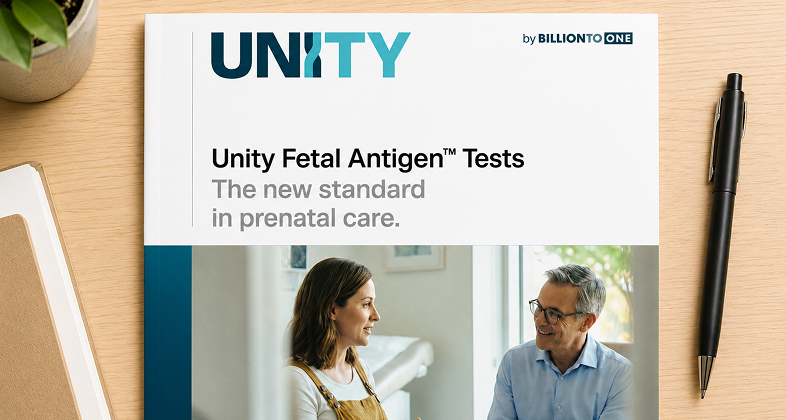
Industry-leading fetal antigen testing from cell-free DNA.
Unity Fetal Antigen tests are designed to streamline care by delivering early, accurate fetal antigen status for RhD-negative and alloimmunized pregnancies at-risk for HDFN and FNAIT.
Comprehensive fetal antigen testing for when clinical needs arise.
Unity Fetal Antigen Tests were developed to streamline care by delivering early, accurate fetal antigen status, enabling appropriate monitoring of at-risk pregnancies and providing peace of mind to those not at-risk.
>99.9%
demonstrated sensitivity1,2,3
>99.9%
demonstrated specificity1,2,3
100%
demonstrated concordance with
neonatal outcomes1,2,3
<0.1%
demonstrated no-call rate1,3
Moving the field forward. Again.
Add Unity Fetal Antigen Tests to Unity Aneuploidy NIPT as early as 9 weeks gestation or at any point during pregnancy — with no additional order or blood draw required.*
Unity AneuploidyTM NIPT

- Trisomy 21*
- Trisomy 18*
- Trisomy 13*
- Sex Chromosome Aneuploidies:
X, XXY, XYY, XXX - Zygosity
- 22q11.2 Microdeletion Syndrome*
- Fetal Sex*

Unity Fetal AntigenTM Tests
- Big C, little c, D, E, e, Fya (Duffy), Fyb (Duffy), jka (Kidd), jkb (Kidd), K (Kell), k, M, N, Big S, little s, U
- *M and N antigens must be selected at ordering and cannot be added after the test is submitted
- HPA-1a (with HLA-DRB3*01:01 when applicable), HPA-1b, HPA-2a, HPA-2b, HPA-3a, HPA-3b, HPA-4a, HPA-4b, HPA-5a, HPA-5b, HPA-9a, HPA-9b, HPA-15a, HPA-15b
Unity ConfirmTM
Non-invasive confirmatory testing for patients who receive high-risk Unity Aneuploidy NIPT results.*
Powered by Fetal Cell Capture™ technology, Unity Confirm uses whole genome sequencing of intact circulating fetal cells.
Only with Unity Aneuploidy NIPT
Unity Fetal RhD™ NIPT
for non-alloimmunized RhD-negative pregnancies
Accurately determines fetal RhD status from maternal blood and available as early as 9 weeks gestation, helping clinicians avoid unnecessary RhoGAM intervention in ~40% of RhD-negative patients.4

Designed to detect the presence or absence of the RHD gene deletion, RHD-CE-D hybrid gene and RHDѰ - variants common in Black and Asian populations5,6
No additional blood draw required; easily added to any Unity Aneuploidy NIPT order

Fetal RhD antigen status is often unknown without invasive procedure

All RhD-negative mothers receive Rh₀(D) immune globulin

Determines fetal RhD antigen status

40% of fetuses are identified as RhD negative; Rh₀(D) immune globulin not indicated4
Non-invasive determination of fetal Rh status is now possible through the analysis of cell-free DNA in maternal plasma. Up to 40% of RhD–negative pregnant women will carry an RhD–negative fetus. In this clinical situation, antenatal anti-D immune globulin (e.g., RhoGAM) administration is unnecessary.
— ACOG Practice Bulletin #181
Unity Fetal Antigen™ NIPT
for alloimmunized pregnancies
Available as early as 9 weeks gestation, Unity Fetal Antigen NIPT delivers early, accurate fetal antigen status from a maternal blood sample.
Unity Fetal Antigen Tests were developed to streamline care by delivering early, accurate fetal antigen status, enabling appropriate monitoring of at-risk pregnancies and providing peace of mind to those not at-risk.
First-and-only test available in the US to screen for both red blood cell (RBC) and platelet fetal antigen status via cell-free DNA.
Designed to detect the presence or absence of up to 16 red blood cell and common platelet fetal antigens, including HPA-1a.
No additional blood draw required; easily added to any Unity Aneuploidy NIPT order*

HDFN affects ~1% of pregnancies, with clinical outcomes ranging from mild anemia to hydrops and stillbirth.
FNAIT may lead to catastrophic fetal consequences such as thrombocytopenia, intracranial hemorrhage, or fetal loss.

Partner sample collected to determine antigen status (assuming partner is available).

If partner is antigen positive, invasive diagnostic testing offered but frequently declined.

Titers are monitored frequently via maternal blood draw.

Regular middle cerebral arterial Doppler assessment may be recommended.

Baby likely to be delivered early.

Unity Fetal Antigen NIPT ordered.

Fetal antigen status provided as “detected” or “not detected” to guide pregnancy management.

Up to 65% of pregnancies are not at risk8
Additional Provider Resources.
Product Information


Unity Fetal Antigen™ TRF

MFM Perspective

Innovation with Unity does not stop here.
When you choose Unity, you are partnering with a company committed to advancing prenatal care and redefining how patients and providers navigate prenatal testing. Request a test kit for your clinic today to streamline access and elevate patient care.
Unity tests can produce false-positive and false-negative results. Results are not a guarantee. Amniocentesis should always be considered with high risk results. Important medical decisions should not rely on Unity test results alone. Clinical correlation is necessary, including but not limited to the results of prior and further prenatal testing. Unity tests are laboratory-developed tests performed in a CLIA-certified and CAP-accredited laboratory. They are not FDA-approved or FDA-cleared diagnostic tests. Test performance may vary based on gestational age and other factors.
References
Alford, B. et al. Validation of a non-invasive prenatal test for fetal RhD, C, c, E, K and Fya antigens. Sci Rep 13, 12786 (2023). https:// doi.org/10.1038/s41598-02339283-3.
Mateus Nino, Julio F., et al. “Clinical performance of cell-free DNA for fetal RhD detection in RhD-negative pregnant individuals in the United States.” Obstetrics & Gynecology 145.4 (2025): 402-408.
Rego, Shannon et al. “Cell-Free DNA Analysis for the Determination of Fetal Red Blood Cell Antigen Genotype in Individuals With Alloimmunized Pregnancies.” Obstetrics and gynecology vol. 144,4 (2024): 436-443. doi:10.1097/ AOG.0000000000005692.
Prevention of Rh D Alloimmunization. Obstetrics & Gynecology 130(2):p e57-e70, August 2017. DOI: 10.1097/AOG.0000000000002232.
Singleton, B. (2000). The presence of an RHD pseudogene containing a 37 base pair duplication and a nonsense mutation in Africans with the Rh D-negative blood group phenotype. Blood, 95(1), 12–18. https://doi.org/10.1182.
Zhang J, et al. RHD Genotypes in a Chinese Cohort of Pregnant Women. Front Genet. 2021 Dec 14;12:752485. doi: 10.3389/fgene.2021.752485. PMID: 34970297; PMCID: PMC8712876.
Moise, Kenneth J., Jr., et al. “A Clinical Practice Guideline for the Management of Pregnancy Alloimmunized to Red Blood Cell Antigens.” JAMA Network Open, vol. 8, no. 11, 24 Nov. 2025, e2544649. doi:10.1001/jamanetworkopen.2025.44649
Koelewijn, Johanna Maria, et al. “Effect of screening for red cell antibodies, other than anti‐D, to detect hemolytic disease of the fetus and newborn: a population study in the Netherlands.” Transfusion 48.5 (2008): 941–952