
The new standard in prenatal care.
One blood draw from mom. Pregnancy-specific insights into fetal risk for recessive conditions, aneuploidies, and beyond — including optional, non-invasive confirmatory testing for high-risk Unity Aneuploidy NIPT results*
We don’t build tests to match the market. We build tests to move care forward.
Discover what sets Unity Complete apart.
Designed as a first-line screen for the general obstetric population, Unity Complete delivers accurate fetal risk assessment for recessive conditions, aneuploidies, and more — with access to the first and only non-invasive confirmatory test for patients who receive a high-risk Unity Aneuploidy™ NIPT result.*

Innovation driven by clinical need
Available as early as 9 weeks into pregnancy, Unity Complete is designed to deliver industry-leading fetal risk assessment, highly accurate aneuploidy screening, and first-of-kind testing to determine fetal RhD and fetal antigen status — all from a single maternal blood sample.

Detect more affected pregnancies
Unity Fetal Risk Screen leverages cell-free DNA to provide direct insights to the fetus, translating to ~3X increase in detection of affected pregnancies compared to traditional carrier screening.¹

Reassure 99% of pregnant patients, early in their pregnancy
The majority of patients will learn they are at a significantly reduced risk of having an affected fetus.
Less than 1% of patients will receive a high fetal risk report, as early as the first trimester.¹
For those patients who receive a high-risk result and cannot, or choose not to, pursue invasive diagnostic testing, Unity Confirm provides accessible, non-invasive confirmatory testing after a high-risk Unity Aneuploidy™ NIPT result.*

Designed for a general obstetric population
Unity screens for conditions aligned to ACOG screening recommendations for a general obstetric population.2,3
Unity Complete.
Unity Complete® is the only prenatal test that goes from screening to confirmation.
Unity Complete screens for recessive and chromosomal conditions aligned with ACOG screening recommendations.* Patients who are RhD-negative or alloimmunized may also benefit from Unity Fetal Antigen™ tests, which can be added to Unity Aneuploidy™ NIPT at any point during pregnancy.
Unity Fetal RiskTM Screen

- Cystic Fibrosis‡
- Sickle Cell Disease
- Beta-Thalassemia
- Spinal Muscular Atrophy
- Alpha-Thalassemia
- 5-Gene Panel
- Canavan Disease
- MCAD Deficiency
- Tay-Sachs Disease
- Familial Dysautonomia
- Smith-Lemli-Opitz Syndrome
- PMM2-Congenital Disorder of Glycosylation
- DMD-Associated Dystrophinopathies*
- Phenylalanine Hydroxylase Deficiency (PKU)
- Fragile X Syndrome*†
Unity AneuploidyTM NIPT
- Trisomy 21*
- Trisomy 18*
- Trisomy 13*
- Sex Chromosome Aneuploidies:
X, XXY, XYY, XXX - Zygosity
- 22q11.2 Microdeletion Syndrome*
- Fetal Sex*

Unity Fetal AntigenTM Tests
- Big C, little c, D, E, e, Fya (Duffy), Fyb (Duffy), jka (Kidd), jkb (Kidd), K (Kell), k, M, N, Big S, little s, U
- *M and N antigens must be selected at ordering and cannot be added after the test is submitted
- HPA-1a (with HLA-DRB3*01:01 when applicable), HPA-1b, HPA-2a, HPA-2b, HPA-3a, HPA-3b, HPA-4a, HPA-4b, HPA-5a, HPA-5b, HPA-9a, HPA-9b, HPA-15a, HPA-15b
Unity ConfirmTM
Non-invasive confirmatory testing for patients who receive high-risk Unity Aneuploidy NIPT results.*
Powered by Fetal Cell Capture™ technology, Unity Confirm uses whole genome sequencing of intact circulating fetal cells.
Only with Unity Aneuploidy NIPT
Unity measures what matters.
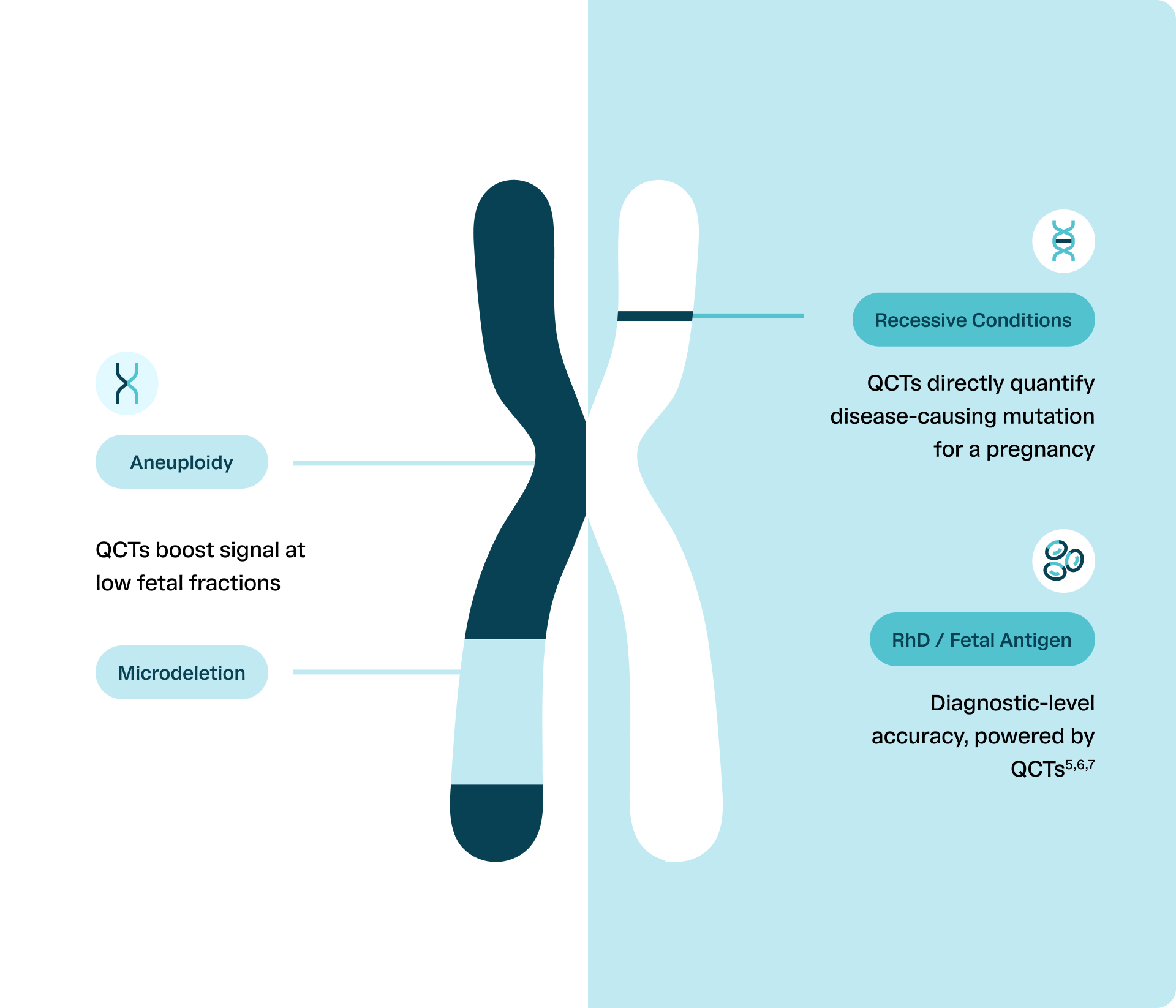
Exclusive to Unity, Quantitative Counting Templateᵀᴹ (QCTᵀᴹ) technology does what other technologies cannot: precisely quantify the disease-causing mutations in cfDNA to deliver a pregnancy-specific fetal risk assessment for up to 14 recessive and X-linked genes with >95% sensitivity.⁴
Additional Provider Resources.
Unity Complete Brochure


Test Requisition Form

Unity Confirm Brochure
Carrier Frequencies


MFM Perspective

Innovation with Unity does not stop here.
When you choose Unity, you are partnering with a company committed to advancing prenatal care and redefining how patients and providers navigate prenatal testing. Request a test kit for your clinic today to streamline access and elevate patient care.
Unity tests can produce false-positive and false-negative results. Results are not a guarantee. Amniocentesis should always be considered with high risk results. Important medical decisions should not rely on Unity test results alone. Clinical correlation is necessary, including but not limited to the results of prior and further prenatal testing. Unity tests are laboratory-developed tests performed in a CLIA-certified and CAP-accredited laboratory. They are not FDA-approved or FDA-cleared diagnostic tests. Test performance may vary based on gestational age and other factors.
References
Wynn J, et al. Performance of single-gene noninvasive prenatal testing for autosomal recessive conditions in a general population setting. Prenat Diagn. 2023 Sep; 43(10):1344-1354. doi: 10.1002/pd.6427. Epub 2023 Sep 6. PMID: 37674263.
Carrier screening for genetic conditions. Committee Opinion No. 691.American College of Obstetricians and Gynecologists. Obstet Gynecol 2017;129:e41–55.
Practice Bulletin No. 163: Screening for Fetal Aneuploidy. Obstet Gynecol. 2016 May;127(5):e123-e137. doi: 10.1097/AOG.0000000000001406. PMID: 26938574.
For autosomal recessive conditions, the clinical sensitivity refers to the estimated clinical detection rate of high-risk fetuses by cfDNA fetal riskassessment. For X-linked conditions, for which cfDNA testing is only clarified via fetal sex, the clinical sensitivity refers to carrier screening detection and does not account for de novomutations.
Alford, B. et al. Validation of a non-invasive prenatal test for fetal RhD, C, c, E, K and Fya antigens. Sci Rep 13, 12786 (2023). https://doi.org/10.1038/s41598-023-39283-3
MateusNino, Julio F., et al. “Clinical performance of cell-free DNA for fetal RhD detection in RhD-negative pregnant individuals in the United States.” Obstetrics
Rego, Shannon, et al. “Cell-free DNA analysis for the determination of fetal red blood cell antigen genotype in individuals with alloimmunized pregnancies.” Obstetrics & Gynecology (2022): 10-1097